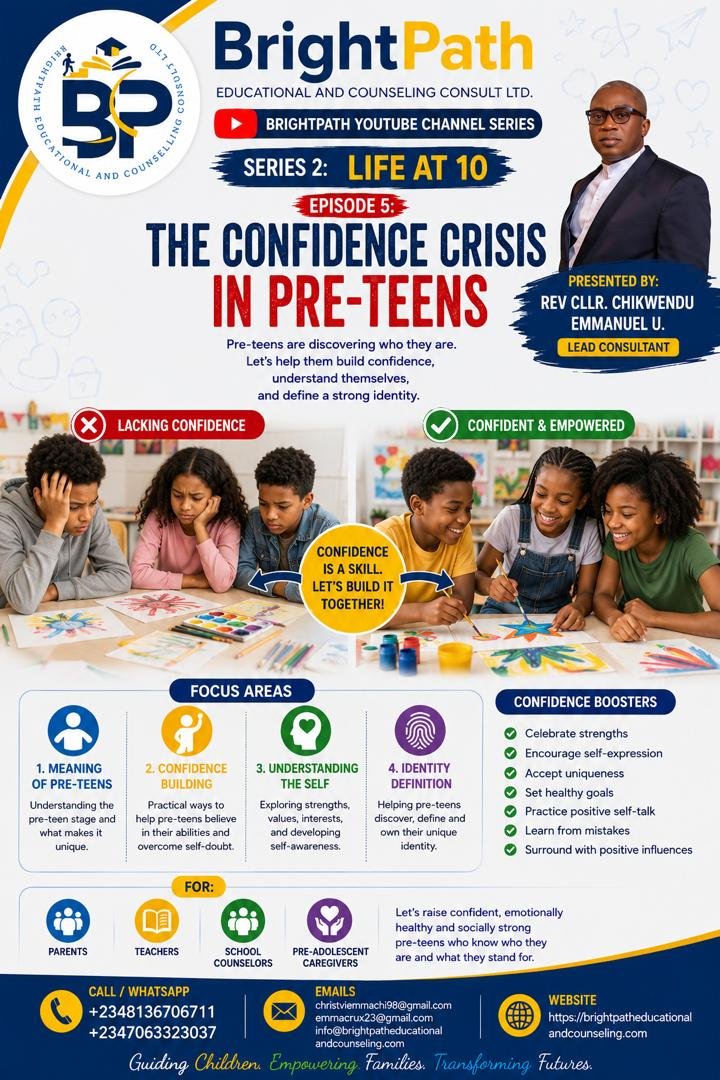
Life At 10, Episode 5: The Confidence Crisis in Pre-Teens

The transition from childhood to adolescence is one of the most important stages of human development. During this period, children begin to experience physical, emotional, social, and cognitive changes that affect how they view themselves and relate to others.
Many pre-teens struggle with self-doubt, peer influence, comparison, fear of rejection, and uncertainty about their identity. If not properly guided, these challenges can lead to low self-esteem and confusion about who they are becoming.
This episode helps parents, teachers, and counselors understand the confidence challenges pre-teens face and how to support them effectively.
Focus Area 1: Understanding the Meaning of a Pre-Teen
Key Question:
Who is a pre-teen?
Discussion Points:
- A pre-teen is a child transitioning from childhood into adolescence.
- Typically between ages 9 and 12 years.
- Experiences rapid emotional, social, and physical development.
- Begins seeking independence while still needing guidance.
- Becomes increasingly influenced by peers and social environments.
Common Characteristics:
✔️ Increased self-awareness.
✔️ Strong desire for acceptance.
✔️ Growing curiosity about identity.
✔️ Sensitivity to criticism and rejection.
✔️ Greater concern about appearance and social status.
Core Message:
Pre-teens are no longer little children, but they are not yet teenagers. They need understanding, guidance, and support during this transition.
Focus Area 2: Confidence Building – Helping Pre-Teens Believe in Themselves
Key Question:
Why do many pre-teens experience a confidence crisis?
Discussion Points:
- Comparing themselves with peers.
- Fear of failure and rejection.
- Academic and social pressures.
- Changes in appearance and body image.
- Growing awareness of strengths and weaknesses.
Warning Signs of Low Confidence:
- Negative self-talk.
- Avoiding challenges.
- Excessive need for approval.
- Fear of expressing opinions.
- Withdrawal from activities.
How Adults Can Help:
- Encourage effort rather than perfection.
- Praise strengths and progress.
- Create opportunities for success.
- Help pre-teens develop problem-solving skills.
- Listen without judgment.
Core Message:
Confidence grows when children learn that their worth is not determined by mistakes, popularity, or performance.
Focus Area 3: Understanding the Self
Key Question:
Why is self-understanding important during the pre-teen years?
Discussion Points:
- Self-awareness forms the foundation of healthy identity.
- Pre-teens begin asking:
- Who am I?
- What am I good at?
- Where do I belong?
- What makes me different?
Areas of Self-Discovery:
- Talents and abilities.
- Interests and passions.
- Values and beliefs.
- Personality traits.
- Dreams and aspirations.
Practical Strategies:
✔️ Encourage self-reflection.
✔️ Help children identify strengths.
✔️ Expose them to positive experiences.
✔️ Support exploration of interests.
✔️ Avoid unhealthy comparisons.
Core Message:
The better children understand themselves, the less they depend on others to define them.
Focus Area 4: The Issue of Identity Definition
Key Question:
How do pre-teens begin defining their identity?
Discussion Points:
- Identity refers to how individuals see and understand themselves.
- During pre-adolescence, children begin forming a clearer sense of self.
- Identity can be influenced by:
- Family values.
- Friendships.
- School experiences.
- Social media.
- Community and culture.
Challenges:
- Peer pressure.
- Desire to fit in.
- Fear of being different.
- Confusion about personal strengths and values.
What Adults Can Do:
- Help children appreciate their uniqueness.
- Encourage healthy decision-making.
- Model positive self-esteem.
- Provide a safe environment for self-expression.
Core Message:
A strong identity develops when children learn to value who they are rather than trying to become someone else.
Practical Takeaways for Parents, Teachers, and Counselors
Teach Pre-Teens:
✔️ Your worth is not based on popularity.
✔️ Mistakes are opportunities to learn.
✔️ Being different is not a weakness.
✔️ Confidence comes from growth, not perfection.
✔️ Your identity should be built on values, character, and purpose.
✔️ You are uniquely designed with strengths and potential.
BrightPath Closing Reflection
“The pre-teen years are a bridge between childhood and adolescence. During this period, children begin searching for confidence, identity, and belonging. The voices they hear from parents, teachers, counselors, and caregivers can either strengthen or weaken their self-belief. When we help pre-teens understand themselves, discover their strengths, and embrace their uniqueness, we equip them with the confidence needed to navigate life successfully.”