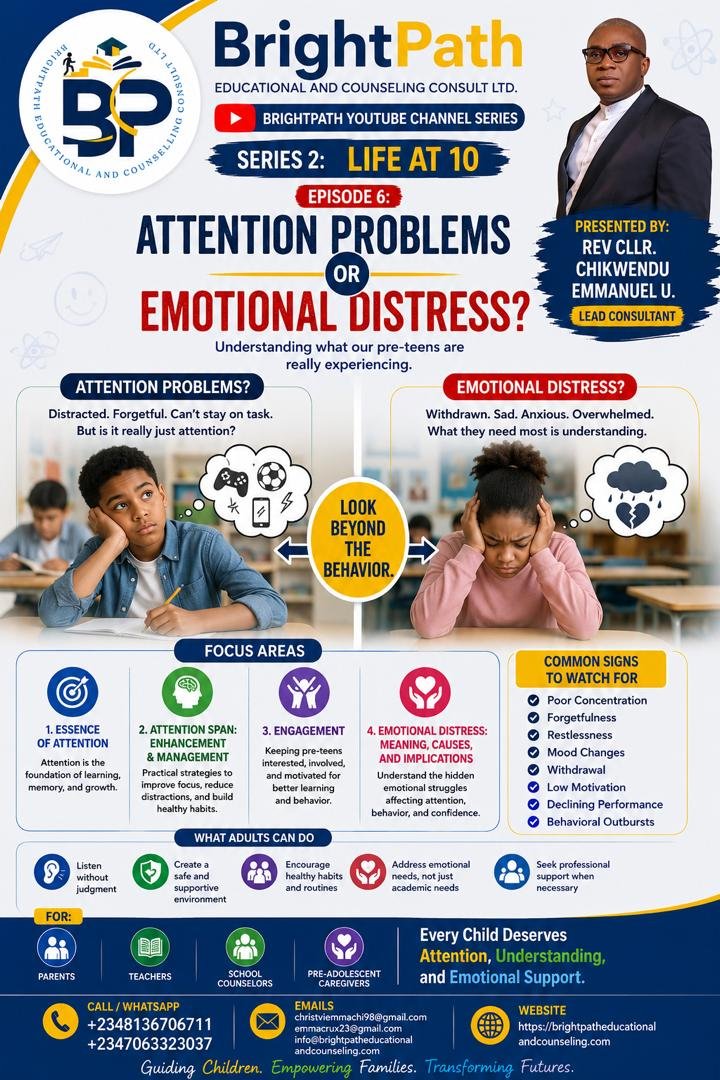
Life At 10, Episode 6: Attention Problems or Emotional Distress

Many parents and teachers often assume that a child who is distracted, restless, forgetful, or disengaged has an attention problem. However, what appears to be poor concentration may actually be a sign of emotional distress. Anxiety, fear, bullying, family conflict, grief, academic pressure, and low self-esteem can significantly affect a child’s ability to focus.
This episode helps adults understand the difference between genuine attention difficulties and emotional challenges that interfere with learning, behavior, and social development.
Focus Area 1: The Essence of Attention
Key Question:
Why is attention important in a child’s development?
Discussion Points:
- Attention is the ability to focus mental energy on a task, activity, or information.
- It is the foundation of learning, memory, problem-solving, and decision-making.
- Children use attention to listen, follow instructions, complete assignments, and interact socially.
- Strong attention skills support academic success and emotional regulation.
Signs of Healthy Attention:
✔️ Ability to stay focused on tasks.
✔️ Following instructions effectively.
✔️ Completing assignments.
✔️ Listening actively.
✔️ Participating meaningfully in learning activities.
Core Message:
Attention is the gateway through which learning, understanding, and growth occur.
Focus Area 2: Attention Span – Enhancement and Management
Key Question:
How can children improve and manage their attention span?
Discussion Points:
- Attention span develops gradually with age.
- Not all children can focus for the same length of time.
- Modern distractions, excessive screen time, stress, and fatigue can reduce concentration.
Practical Strategies for Enhancing Attention:
At Home:
- Establish structured routines.
- Reduce unnecessary distractions.
- Encourage adequate sleep.
- Promote healthy nutrition.
- Balance screen time with physical activity.
At School:
- Use interactive teaching methods.
- Break tasks into smaller segments.
- Provide clear instructions.
- Encourage active participation.
- Offer positive reinforcement.
Attention Builders:
✔️ Reading regularly.
✔️ Puzzle-solving.
✔️ Educational games.
✔️ Creative activities.
✔️ Mindfulness and relaxation exercises.
Core Message:
Attention is a skill that can be developed through consistent practice and supportive environments.
Focus Area 3: Engagement – The Key to Sustained Attention
Key Question:
Why do some children pay attention while others seem disconnected?
Discussion Points:
- Children focus more on activities they find meaningful and interesting.
- Engagement increases motivation and participation.
- Learning becomes easier when children feel involved.
- Positive teacher-student and parent-child relationships improve engagement.
Signs of Healthy Engagement:
- Curiosity and enthusiasm.
- Asking questions.
- Participating actively.
- Taking initiative.
- Showing persistence when tasks become difficult.
How Adults Can Improve Engagement:
- Connect learning to children’s interests.
- Encourage hands-on experiences.
- Celebrate progress and effort.
- Create emotionally safe learning environments.
Core Message:
Engagement fuels attention, and attention fuels learning.
Focus Area 4: Emotional Distress – Meaning, Possible Causes, and Implications
Key Question:
When is poor attention actually a sign of emotional distress?
Meaning of Emotional Distress:
Emotional distress refers to psychological discomfort that affects a child’s thoughts, feelings, behavior, and ability to function effectively.
Possible Causes:
Family-Related Factors:
- Family conflict.
- Separation or divorce.
- Neglect.
- Poor parent-child relationships.
- Financial hardship.
School-Related Factors:
- Bullying.
- Academic pressure.
- Fear of failure.
- Social rejection.
- Teacher-related stress.
Personal Factors:
- Low self-esteem.
- Anxiety.
- Grief and loss.
- Loneliness.
- Trauma.
Signs of Emotional Distress:
✔️ Difficulty concentrating.
✔️ Frequent sadness.
✔️ Irritability.
✔️ Social withdrawal.
✔️ Declining academic performance.
✔️ Changes in eating or sleeping habits.
✔️ Excessive worry or fear.
Possible Implications:
- Reduced academic achievement.
- Behavioral difficulties.
- Relationship challenges.
- Increased anxiety and depression.
- Low self-confidence.
- Long-term emotional difficulties if ignored.
Core Message:
Sometimes a distracted child is not refusing to learn; they may be struggling emotionally and silently asking for help.
Practical Takeaways for Parents, Teachers, and Counselors
Ask Before Assuming:
Instead of saying:
“Why can’t you pay attention?”
Try asking:
“Is something bothering you?”
Support Children By:
✔️ Listening without judgment.
✔️ Creating emotionally safe environments.
✔️ Encouraging open communication.
✔️ Addressing sources of stress.
✔️ Seeking professional support when necessary.
✔️ Recognizing emotional needs alongside academic needs.
BrightPath Reflection
“Behind every inattentive child is a story waiting to be understood. Sometimes the challenge is attention; sometimes it is emotional pain. When adults learn to look beyond behavior and understand the child’s emotional world, they create opportunities for healing, growth, and success. Attention improves when children feel safe, valued, understood, and supported.”