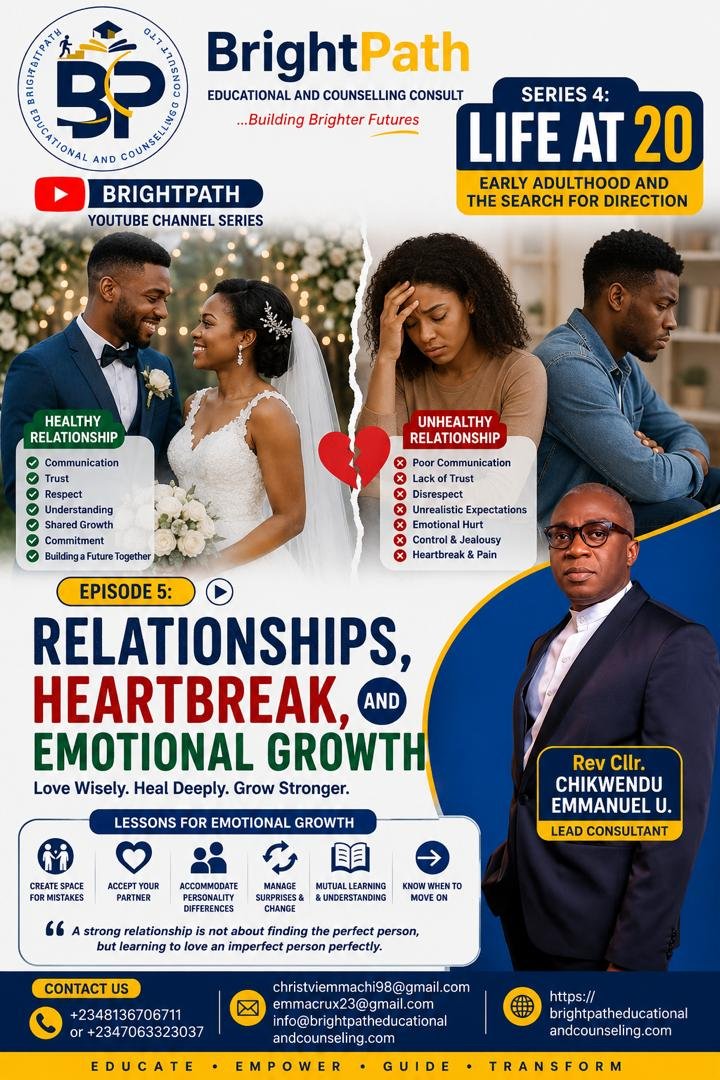
Life At 20, Episode 5: Relationships, Heartbreak, and Emotional Growth

Your twenties are often the period when many people experience their first serious romantic relationships.
Some relationships blossom into lifelong partnerships.
Others become valuable life lessons.
Unfortunately, many young adults enter relationships with unrealistic expectations, believing that love alone is enough.
Healthy relationships require maturity, communication, patience, understanding, forgiveness, and continuous growth.
Question 1
Why Are Relationships So Important in Your Twenties?
Relationships contribute to:
- Emotional development.
- Self-discovery.
- Communication skills.
- Conflict resolution.
- Understanding personal values.
- Preparing for future family life.
However, relationships should complement your life—not become your entire identity.
Question 2
The Inability to Create Space for Mistakes
One of the greatest challenges in relationships is expecting perfection.
Every human being makes mistakes.
Healthy partners understand that:
- mistakes are opportunities for learning,
- correction is better than condemnation,
- growth takes time.
Creating space for mistakes does not mean accepting abuse, manipulation, or repeated harmful behavior.
It means recognizing that imperfect people can learn and improve through honest communication and accountability.
Question 3
Accepting Your Partner as They Are
Many relationships fail because one partner constantly tries to change the other.
Acceptance means appreciating:
- personality,
- background,
- strengths,
- weaknesses,
- dreams,
- differences.
Acceptance is not settling for unhealthy behavior.
Rather, it means loving someone realistically—not an imaginary version of who you wish they were.
Question 4
Accommodating Your Partner’s Personality
No two people are exactly alike.
One partner may be:
- outgoing,
- expressive,
- adventurous.
The other may be:
- quiet,
- reflective,
- cautious.
Understanding personality differences helps couples avoid unnecessary conflicts.
Healthy relationships ask:
“How can we complement each other instead of competing with each other?”
Respecting differences creates emotional safety.
Question 5
Managing Surprises and Change
Life changes.
People change.
Careers change.
Priorities change.
Unexpected situations may include:
- relocation,
- job loss,
- financial challenges,
- family responsibilities,
- personal growth,
- changing goals.
Strong relationships adapt through:
- honest conversations,
- flexibility,
- empathy,
- teamwork,
- shared problem-solving.
Growth together is often more important than remaining the same.
Question 6
Mutual Learning and Understanding
Healthy relationships are classrooms—not battlefields.
Partners should continually learn:
- how each other communicates,
- emotional needs,
- love languages,
- strengths,
- weaknesses,
- dreams,
- fears.
Successful relationships involve two lifelong learners.
Instead of asking,
“How can my partner make me happy?”
Ask,
“How can we grow together?”
Question 7
Heartbreak: A Painful but Powerful Teacher
Heartbreak can leave emotional wounds.
It may bring:
- sadness,
- disappointment,
- anger,
- loneliness,
- self-doubt.
While painful, heartbreak can also teach valuable lessons:
- emotional resilience,
- better judgment,
- healthier boundaries,
- self-awareness,
- personal growth.
Pain should become a teacher—not a permanent home.
Question 8
Knowing When to Move On
Not every relationship is meant to last forever.
Sometimes moving on is the healthiest decision.
Reasons may include:
- persistent disrespect,
- emotional or physical abuse,
- repeated dishonesty,
- incompatible life goals,
- lack of trust,
- refusal to grow.
Moving on is not failure.
Sometimes it is wisdom.
Healing requires:
- accepting reality,
- forgiving where possible,
- learning from the experience,
- focusing on personal growth,
- allowing yourself time to recover.
BrightPath Professional Tips
If you’re experiencing relationship challenges:
✔️ Love with wisdom, not only emotions.
✔️ Communicate honestly and respectfully.
✔️ Accept imperfections while maintaining healthy boundaries.
✔️ Learn your partner’s personality and communication style.
✔️ Never lose your personal identity in a relationship.
✔️ Avoid comparing your relationship to social media.
✔️ Seek counselling when conflicts become overwhelming.
✔️ Learn from heartbreak instead of allowing it to define you.
✔️ Continue investing in your education, career, and personal development.
✔️ Remember that emotional maturity is one of the strongest foundations of lasting relationships.
Reflection Questions
Ask yourself:
- Am I emotionally ready for a healthy relationship?
- Do I expect perfection from others?
- How do I respond when conflicts arise?
- What have my past relationships taught me?
- Am I growing emotionally each year?
- What qualities should I develop before expecting them from someone else?
Key Takeaways
- Relationships during your twenties are opportunities for emotional learning and personal growth.
- Healthy relationships require patience, communication, respect, and mutual understanding.
- Accepting your partner means appreciating their humanity while maintaining healthy boundaries.
- Personality differences should be understood and respected rather than criticized.
- Heartbreak, though painful, can strengthen emotional resilience and wisdom.
- Moving on from unhealthy relationships is sometimes the healthiest act of self-respect.
- Emotional maturity is more valuable than emotional intensity.
Closing
“Love is not about finding a perfect person; it is about two imperfect people choosing to grow together with honesty, patience, and mutual respect. If a relationship ends, let it leave you wiser—not bitter. Build your character, protect your peace, and never stop growing. The healthiest relationships begin with healthy individuals.”