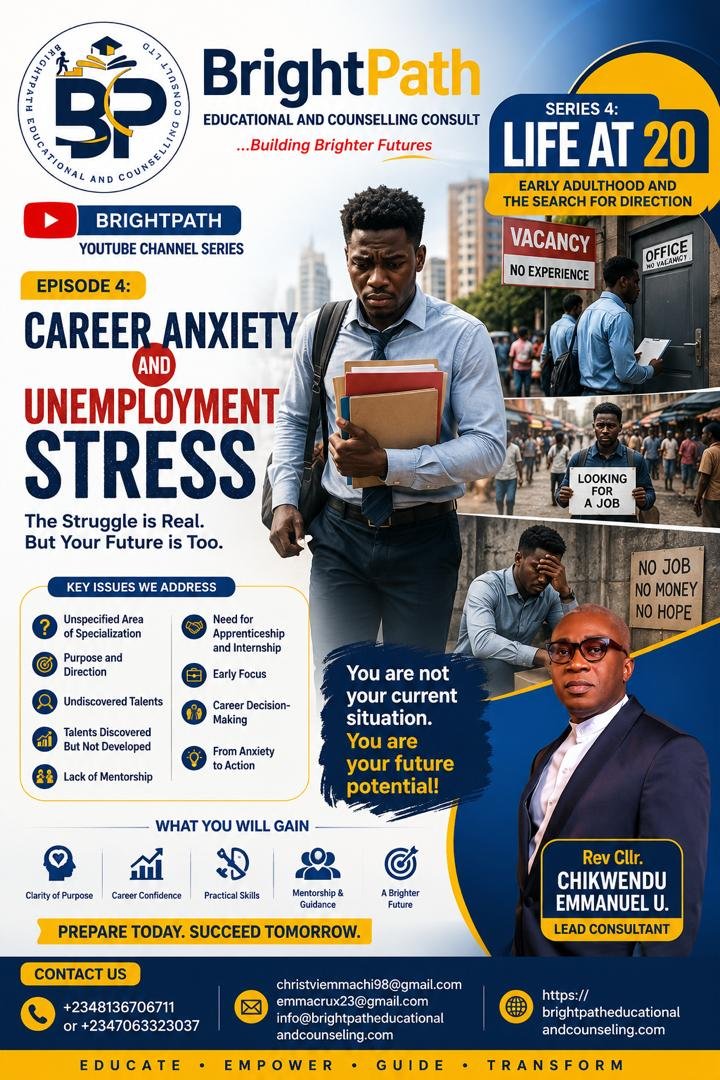
Life At 20, Episode 4: Career Anxiety and Unemployment Stress

For many young adults, one of the greatest sources of anxiety is the fear of not finding meaningful work.
Some graduate without knowing what career truly suits them.
Others have talents but have never developed them.
Some have dreams but lack guidance, mentorship, practical experience, or opportunities.
The good news is that career success is not merely about finding a job—it is about discovering your purpose, developing your abilities, and creating value for society.
Question 1
What Is Career Anxiety?
Career anxiety is the persistent worry or fear about one’s future career, employment, or professional growth.
It often includes concerns such as:
- “Will I get a job after graduation?”
- “Am I studying the right course?”
- “What if I choose the wrong career?”
- “Why are my friends progressing faster than I am?”
- “What if I never discover my purpose?”
While these concerns are common, they should motivate preparation rather than create hopelessness.
Question 2
Why Are Many Young Adults Uncertain About Their Area of Specialization?
Many students enter universities without a clear understanding of their interests or career goals.
Some choose courses because of:
- parental pressure,
- peer influence,
- societal expectations,
- admission opportunities,
- financial considerations,
- lack of career guidance.
Without adequate self-understanding, specialization becomes confusing.
Career choice should be informed by self-awareness, interests, abilities, personality, values, and future opportunities.
Question 3
Purpose: The Foundation of Career Fulfilment
Purpose answers the question:
“Why am I here, and what meaningful contribution can I make?”
Purpose gives direction.
A career without purpose may bring income but not fulfilment.
Discovering your purpose requires:
- self-reflection,
- continuous learning,
- exposure to different opportunities,
- service to others,
- mentorship,
- openness to growth.
Question 4
Undiscovered Talents
Many people possess gifts they have never recognized.
Why?
Because they have never been exposed to environments that allow those talents to emerge.
Examples include talents in:
- leadership,
- teaching,
- technology,
- entrepreneurship,
- counselling,
- music,
- writing,
- public speaking,
- creativity,
- innovation.
Talent discovery often begins by trying new experiences and paying attention to what comes naturally and brings joy.
Question 5
Discovered but Undeveloped Talents
Some people know their strengths but never invest in developing them.
Talent without development remains potential.
Development requires:
- education,
- consistent practice,
- coaching,
- discipline,
- patience,
- lifelong learning.
A gift becomes valuable when it is refined into a skill.
Question 6
The Importance of Mentorship
Many career mistakes can be avoided through mentorship.
A mentor provides:
- guidance,
- encouragement,
- constructive feedback,
- networking opportunities,
- career insights,
- accountability.
Learning from someone who has walked the path before you can save years of confusion.
Question 7
Why Apprenticeship and Internship Matter
Knowledge gained in the classroom is important, but experience transforms knowledge into competence.
Apprenticeship
Allows young adults to learn practical skills directly from experienced professionals.
Internship
Provides exposure to real work environments, teamwork, problem-solving, and professional ethics.
Benefits include:
- practical experience,
- improved confidence,
- employability,
- professional networking,
- career clarity,
- skill development.
Experience often becomes the bridge between education and employment.
Question 8
Why Early Focus Matters
Your twenties are the best time to build strong foundations.
Early focus helps you:
- identify priorities,
- avoid unnecessary distractions,
- develop relevant skills,
- build professional networks,
- gain experience,
- prepare for future leadership.
Focus is not about knowing everything—it is about taking intentional steps toward your goals.
Question 9
Career Decision-Making
Making career decisions involves more than choosing a job.
It requires asking:
- What are my strengths?
- What are my interests?
- What problems do I enjoy solving?
- What values guide my life?
- What skills are in demand?
- Where can I make meaningful contributions?
Good career decisions combine passion, competence, opportunity, and purpose.
BrightPath Professional Tips
If you are experiencing career anxiety:
✔️ Don’t panic if you haven’t figured everything out.
✔️ Invest in self-discovery.
✔️ Take career assessment tests if necessary.
✔️ Learn high-demand digital and professional skills.
✔️ Find a mentor.
✔️ Pursue internships and volunteer opportunities.
✔️ Build your portfolio and practical experience.
✔️ Develop your communication and leadership skills.
✔️ Keep learning and adapting.
✔️ Remember that your career is a journey, not a one-time decision.
Reflection Questions
Ask yourself:
- What am I naturally good at?
- What activities give me energy and satisfaction?
- What skills should I begin developing today?
- Who can mentor me?
- What practical experiences do I need before graduation?
- What legacy do I want my career to create?
Key Takeaways
- Career anxiety is common but can be managed through preparation, self-awareness, and purposeful planning.
- Choosing a specialization should be based on interests, abilities, values, and opportunities—not only external pressure.
- Purpose gives direction and meaning to a career.
- Talents must be discovered, nurtured, and developed through learning and practice.
- Mentorship, internships, and apprenticeships provide valuable experience and guidance.
- Early focus and informed career decisions lay the foundation for long-term success and fulfilment.
Closing
“Your future is not determined by luck alone but by the choices you make today. Don’t let uncertainty stop you from taking the next step. Discover your gifts, develop your talents, seek wise mentors, gain practical experience, and pursue a career that aligns with your purpose. The world needs not just qualified graduates—it needs prepared, purposeful, and resilient young leaders.”