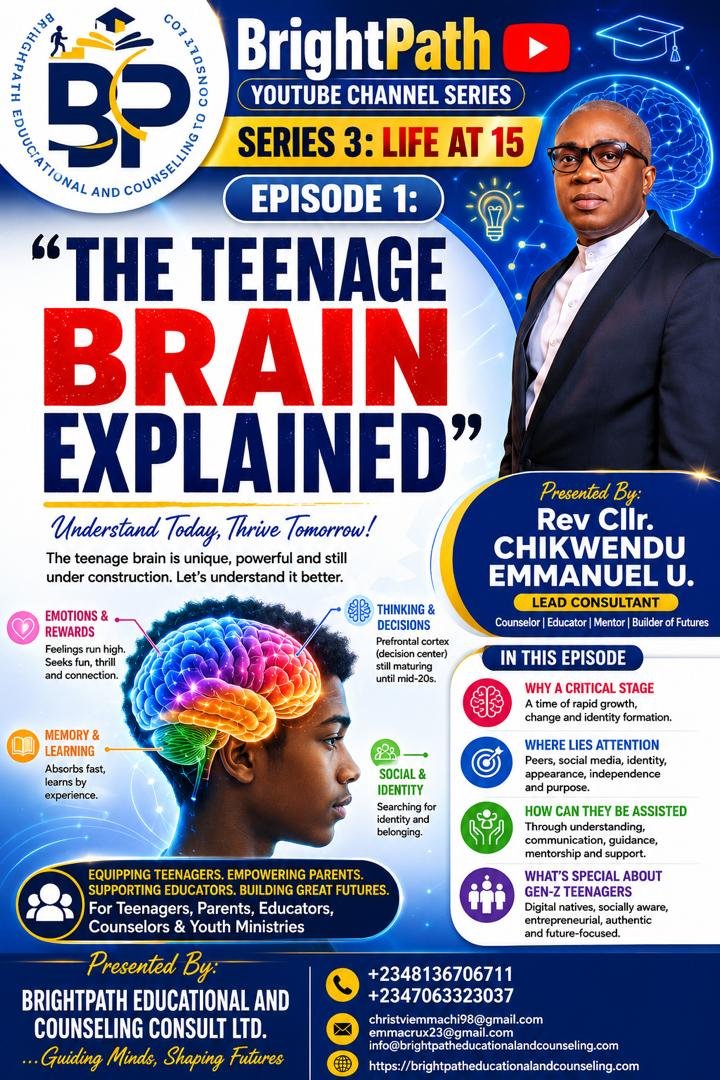
Life At 15, Episode 1: The Teenage Brain Explained

The teenage years are among the most important stages of human development. Between the ages of approximately 13 and 19, young people experience rapid physical, emotional, social, cognitive, and psychological changes. This period is not merely a transition from childhood to adulthood; it is a critical phase during which identity, values, beliefs, and future aspirations begin to take shape.
Many adults often misunderstand teenagers, interpreting their behavior as stubbornness, irresponsibility, or rebellion. However, modern neuroscience shows that much of teenage behavior is linked to the ongoing development of the adolescent brain.
Understanding the teenage brain can help parents, teachers, counselors, and youth leaders provide appropriate guidance and support.
Why Is the Teenage Stage a Critical One?
The teenage stage is critical because it is the period when young people begin to answer some of life’s most important questions:
- Who am I?
- What do I believe?
- Where do I belong?
- What career should I pursue?
- What kind of person do I want to become?
During this stage, teenagers experience:
- Identity Formation
Teenagers begin to develop a personal identity separate from their parents and family.
They start exploring:
- Personal values
- Religious beliefs
- Career interests
- Friendships
- Social roles
This search for identity can sometimes lead to confusion, experimentation, and emotional struggles.
- Increased Emotional Sensitivity
The emotional centers of the brain develop faster than the rational decision-making centers.
As a result:
- Feelings become more intense.
- Rejection hurts more.
- Criticism feels deeper.
- Social acceptance becomes highly important.
- Vulnerability to Risky Behaviors
Teenagers are naturally curious and more likely to:
- Experiment with new experiences
- Take risks
- Seek excitement
- Follow peer influence
Without proper guidance, this can expose them to:
- Substance abuse
- Internet addiction
- Gambling
- Early sexual involvement
- Delinquent behaviors
- Foundation for Adult Life
Many habits formed during adolescence often continue into adulthood.
Examples include:
- Study habits
- Emotional regulation
- Spiritual practices
- Relationship patterns
- Career aspirations
This makes adolescence one of the most influential developmental periods.
Understanding the Teenage Brain
Scientists have discovered that the teenage brain is still under construction.
The brain develops from the back toward the front.
One of the last areas to fully mature is the prefrontal cortex, the region responsible for:
- Planning
- Decision-making
- Self-control
- Problem-solving
- Judgement
- Consequence evaluation
This area continues to develop into the mid-twenties.
Meanwhile, the emotional and reward systems develop earlier.
This creates an imbalance where teenagers often:
- Feel emotions strongly
- Seek excitement
- Desire immediate rewards
- Act before fully considering consequences
This does not mean teenagers are incapable of making good decisions. It simply means they need guidance, support, and opportunities to practice responsible decision-making.
Where Does the Teenage Attention Lie?
Understanding what captures a teenager’s attention is essential for effective parenting, teaching, and counseling.
- Peer Acceptance
For many teenagers, friendships become extremely important.
Questions occupying their minds include:
- Do I fit in?
- Do people like me?
- Am I accepted?
Peer relationships significantly influence:
- Self-esteem
- Behavior
- Decision-making
- Social Media and Technology
Today’s teenagers are digital natives.
They spend considerable time on:
- Social media platforms
- Online gaming
- Video content
- Digital communication
These platforms provide:
- Entertainment
- Social connection
- Information
- Validation
However, excessive use can contribute to:
- Anxiety
- Low self-esteem
- Sleep problems
- Attention difficulties
- Appearance and Self-Image
Physical changes during puberty make teenagers highly conscious of their appearance.
Many compare themselves with:
- Friends
- Celebrities
- Social media influencers
This can affect:
- Confidence
- Body image
- Mental health
- Independence
Teenagers naturally desire greater freedom.
They want opportunities to:
- Make choices
- Express opinions
- Explore interests
- Demonstrate maturity
Healthy independence is a normal developmental need.
- Purpose and Future
Many teenagers increasingly think about:
- Career choices
- Educational opportunities
- Relationships
- Life goals
Though they may not always express it, they are often searching for meaning and direction.
⸻
How Can Teenagers Be Assisted?
Supporting teenagers requires understanding, patience, and intentional guidance.
- Listen More Than You Lecture
Teenagers need adults who genuinely listen.
Instead of immediately correcting or judging:
- Listen carefully.
- Ask questions.
- Show empathy.
When teenagers feel heard, they become more receptive to guidance.
- Build Emotional Safety
Create environments where teenagers can express feelings without fear of ridicule or rejection.
Encourage them to talk about:
- Anxiety
- Stress
- Relationships
- Academic concerns
- Personal struggles
- Teach Emotional Intelligence
Help teenagers learn:
- Self-awareness
- Self-control
- Empathy
- Conflict resolution
- Healthy communication
These skills contribute significantly to future success.
- Encourage Positive Peer Relationships
Guide teenagers toward friendships that promote:
- Responsibility
- Academic growth
- Character development
- Positive values
- Provide Mentorship
Every teenager benefits from trusted adults who can offer guidance and encouragement.
Mentors may include:
- Parents
- Teachers
- Counselors
- Religious leaders
- Coaches
- Promote Balanced Technology Use
Teach responsible digital habits by encouraging:
- Screen-time limits
- Offline activities
- Physical exercise
- Face-to-face relationships
- Support Their Dreams
Help teenagers identify:
- Strengths
- Talents
- Interests
- Career possibilities
Encourage exploration rather than imposing unrealistic expectations
What Is Special About Generation Z Teenagers?
Generation Z generally refers to young people born approximately between 1997 and 2012. Many current teenagers belong to the younger segment of this generation.
They are unique because they have grown up in a highly digital and interconnected world.
Characteristics of Gen Z Teenagers
- Digitally Intelligent
They are comfortable with:
- Smartphones
- Social media
- Online learning
- Artificial Intelligence
- Digital communication
Technology is not a tool they learned; it is part of their daily environment.
- Information-Rich
Gen Z has access to vast amounts of information instantly.
They often seek answers online before consulting adults.
- Socially Aware
Many Gen Z teenagers are interested in:
- Mental health
- Social justice
- Environmental issues
- Diversity and inclusion
They often want their voices heard.
- Entrepreneurial Mindset
Many young people today are interested in:
- Content creation
- Digital businesses
- Freelancing
- Personal branding
They often think creatively about income generation.
- Mental Health Conscious
Unlike previous generations, Gen Z is generally more willing to discuss:
- Anxiety
- Depression
- Stress
- Emotional wellbeing
This openness creates opportunities for early intervention and support.
- Desire for Authenticity
Gen Z values:
- Honesty
- Transparency
- Real relationships
They are often skeptical of authority that appears disconnected from their realities.
BrightPath Takeaway
The teenage brain is not broken; it is developing.
Teenagers are not simply difficult individuals; they are young people navigating one of the most complex stages of life. They are building identity, managing emotions, seeking belonging, and preparing for adulthood—all while their brains are still developing.
Parents, educators, counselors, and youth leaders must move beyond criticism and embrace understanding. When teenagers receive emotional support, positive guidance, mentorship, and opportunities to grow, they become resilient, responsible, and purpose-driven adults.
Remember:
A teenager who is understood today becomes a confident adult tomorrow.