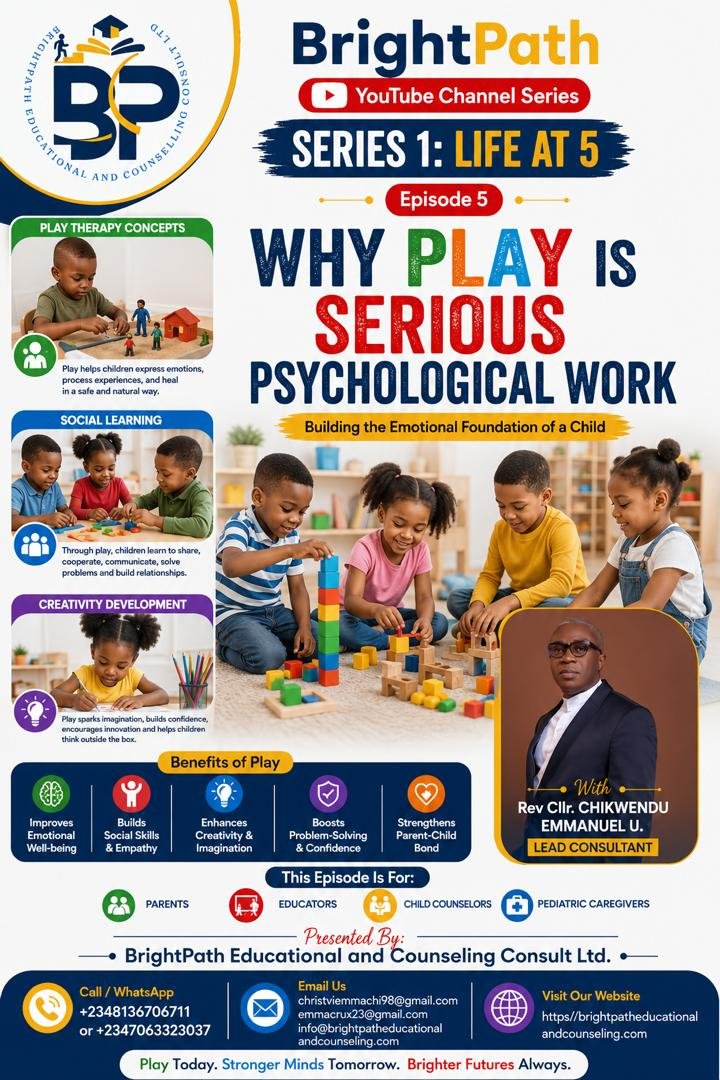
Episode 5: Why Play Is Serious Psychological Work

Introduction
Many adults see play as merely entertainment.
When children are playing, adults often assume they are simply passing the time, having fun, or avoiding serious activities.
However, from a psychological perspective, play is one of the most important activities in childhood.
For a 5-year-old child, play is not a break from learning.
Play is learning.
Through play, children:
- Express emotions
- Solve problems
- Develop social skills
- Build confidence
- Process experiences
- Understand relationships
- Develop creativity
What appears to be simple play is often serious psychological work taking place inside a developing mind.
- Understanding Play as Psychological Work
What is Play?
Play is a voluntary activity that allows children to:
- Explore
- Experiment
- Imagine
- Create
- Communicate
Unlike formal lessons, play allows children to learn naturally.
During play, children develop:
- Cognitive skills
- Emotional skills
- Social skills
- Communication skills
- Problem-solving abilities
⸻
Why Play Matters at Age Five
At age five:
- The brain is rapidly developing
- Emotions are becoming more complex
- Social awareness is increasing
- Language skills are expanding
Play becomes the child’s primary method of understanding the world.
- Play as a Child’s Language
Adults communicate mainly through words.
Children often communicate through play.
Many feelings that children cannot explain verbally may appear during play activities.
For example:
A child who feels afraid may
- Act out fearful stories
- Create rescue scenarios
- Play repeatedly around themes of danger and safety
A child who feels neglected may:
- Create stories about loneliness
- Seek attention through play
- Repeatedly act out family situations
Counseling Insight
Psychologists often observe children’s play because play reveals the following:
- Hidden fears
- Emotional conflicts
- Wishes
- Frustrations
- Unmet emotional needs
Play is often a window into a child’s inner world.
- Understanding Play Therapy Concepts
What is Play Therapy?
Play therapy is a counseling approach that uses play as a tool to help children:
- Express emotions
- Process experiences
- Resolve conflicts
- Build coping skills
Children often struggle to explain emotions directly.
Play provides a safe and natural way for expression.
⸻
Why Play Therapy Works
Children naturally communicate through:
- Toys
- Drawings
- Storytelling
- Pretend play
- Games
Rather than asking:
“Tell me how you feel.”
A counselor may observe:
- How the child plays
- Which themes appear repeatedly
- How relationships are represented
Common Play Therapy Tools
Dolls and Family Figures
Help children express family experiences.
Drawing and Art
Allow emotional expression without words.
Sand Play
Encourages symbolic communication.
Role Play
Helps children explore situations safely.
Storytelling
Reveals emotional understanding and concerns.
- Play and Social Learning
Children Learn Society Through Play
Play teaches children how to:
- Share
- Cooperate
- Take turns
- Negotiate
- Resolve conflicts
- Understand rules
Example
When children play together, they learn:
Cooperation
Working toward a common goal.
Patience
Waiting for turns.
Communication
Expressing ideas appropriately.
Empathy
Understanding another person’s feelings.
Social Skills Developed Through Play
Children learn:
- Friendship skills
- Leadership skills
- Teamwork
- Conflict resolution
- Respect for others
These skills are essential for future success.
- Creativity Development Through Play
Why Creativity Matters
Creativity is not limited to art.
Creativity helps children:
- Solve problems
- Adapt to change
- Generate ideas
- Think independently
Play stimulates creativity by encouraging children to imagine possibilities.
Examples of Creative Play
Pretend Play
A child becomes
- A doctor
- A teacher
- A pilot
- A parent
This develops:
- Imagination
- Communication
- Perspective-taking
Building Activities
Using:
- Blocks
- Construction toys
- Household materials
Children learn:
- Planning
- Problem-solving
- Innovation
Story Creation
When children invent stories, they practice the following:
- Language development
- Creativity
- Emotional understanding
- How Play Supports Emotional Development
Play helps children process emotions such as
Fear
Through imaginative scenarios.
Anger
Through safe expression.
Sadness
Through storytelling and symbolic play.
Anxiety
Through repetitive and comforting activities.
Emotional Benefits of Play
Children who engage in healthy play often develop:
- Better self-control
- Emotional resilience
- Confidence
- Healthy emotional expression
- The Dangers of Limiting Play
Modern childhood faces increasing threats to play:
- Excessive screen time
- Academic pressure
- Overscheduling
- Lack of outdoor opportunities
When play is restricted, children may have fewer opportunities to:
- Explore emotions
- Develop creativity
- Build social competence
- Practice problem-solving
- The Role of Parents and Educators
Adults should see play as an essential developmental activity.
Ways to Support Healthy Play
Provide Time for Free Play
Children need unstructured opportunities to explore.
Reduce Excessive Screen Dependence
Balance technology with active play.
Join Children Occasionally
Shared play strengthens relationships.
Provide Creative Materials
Examples:
- Crayons
- Blocks
- Books
- Costumes
- Art supplies
Encourage Outdoor Activities
Physical play supports both mental and physical health.
- Counseling Insight for Parents
Sometimes the most important emotional conversations happen during play.
A child who struggles to talk about feelings may reveal emotions through:
- Drawings
- Pretend stories
- Games
- Role-playing
Parents who observe play carefully gain valuable insight into their child’s emotional world.
- The Connection Between Play and Future Success
Play develops abilities linked to future success:
- Creativity
- Communication
- Adaptability
- Emotional intelligence
- Leadership
- Problem-solving
Many skills required in adulthood begin developing during childhood play.
Conclusion
Play is not a distraction from development.
Play is development.
Through play, children:
- Learn about themselves
- Learn about others
- Express emotions
- Develop creativity
- Build social skills
- Strengthen emotional resilience
When adults protect and encourage healthy play, they are supporting the emotional, social, and psychological growth of the child.
BrightPath Closing Reflection
“A child at play may appear to be doing something simple, but inside that playful moment, the mind is learning, the emotions are healing, creativity is growing, and the foundation for future success is being built. Play is not wasted time—it is the work of childhood.”