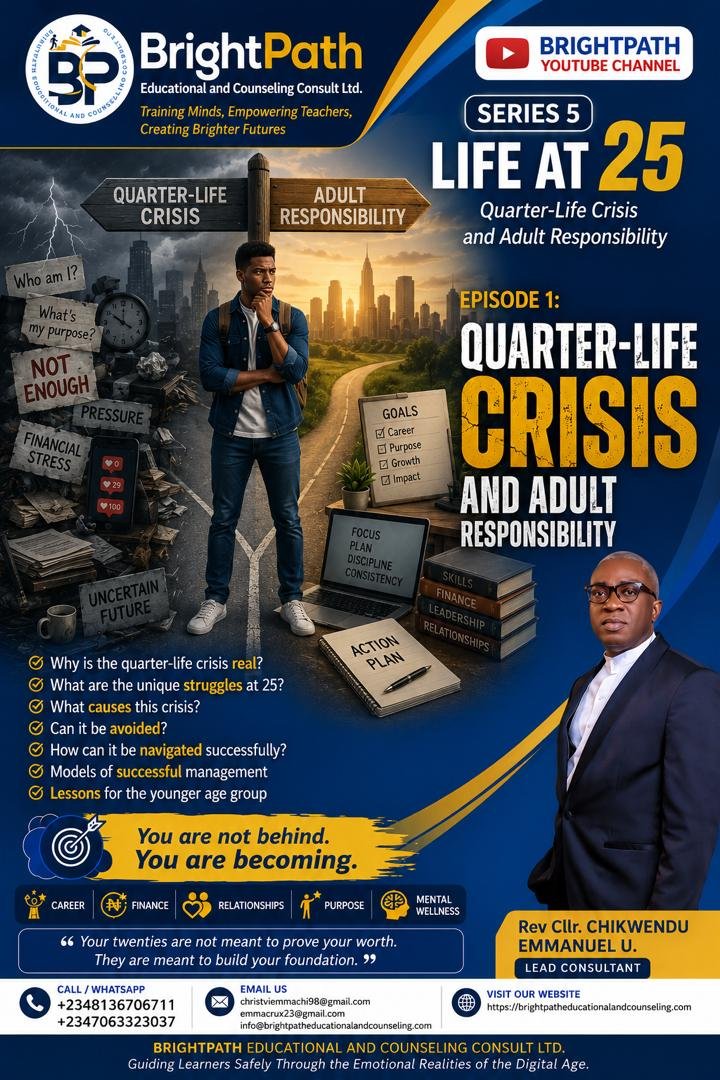
Life At 25, Episode 1: Quarter-Life Crisis and Adult Responsibility

“At 25, why do so many people feel behind in life even though they are only beginning adulthood?”
Many young adults enter their mid-twenties believing they should already have figured out life. Society often sends messages that by 25 one should have a stable career, financial independence, meaningful relationships, professional success, and a clear sense of purpose. When reality does not match these expectations, many experience confusion, anxiety, self-doubt, and emotional exhaustion. This experience has become known as the Quarter-Life Crisis.
Why Is It Called “Quarter-Life”?
The term Quarter-Life Crisis emerged from the assumption that the average human lifespan is approximately 80–100 years. Around age 25, individuals are believed to have completed roughly one-quarter of their expected life journey.
Unlike the midlife crisis that often occurs between ages 40 and 55, the quarter-life crisis occurs during the transition from adolescence and emerging adulthood into full adult responsibility.
This period typically spans between ages 22 and 35, with the intensity often peaking around 24–29 years.
What Makes Age 25 Unique?
The age of 25 sits at the intersection of several major life transitions:
- Completion of formal education.
- Entry into the workforce.
- Financial independence expectations.
- Marriage and relationship decisions.
- Career establishment pressure.
- Social comparison with peers.
- Identity consolidation.
- Responsibility for family and dependents.
Psychologist Jeffrey Arnett describes this stage as Emerging Adulthood, a period characterized by exploration, instability, self-focus, and identity development.
The Unique Crises of the Quarter-Life Stage
- Career Uncertainty
Questions commonly asked include:
- “Did I choose the wrong career?”
- “Why are my mates doing better than me?”
- “Am I wasting my potential?”
Many young adults feel trapped between passion and financial survival.
- Financial Pressure
For many, this is the first period of:
- Paying rent.
- Supporting parents or siblings.
- Managing debts.
- Building savings.
- Facing unemployment or underemployment.
Financial stress often becomes one of the largest contributors to anxiety.
- Relationship Pressure
Young adults may struggle with:
- Fear of commitment.
- Pressure to marry.
- Breakups and heartbreak.
- Balancing career and family goals.
- Comparing their relationship status with peers.
- Identity Confusion
Questions emerge such as:
- Who am I?
- What do I truly want?
- What kind of life do I want to build?
- Am I becoming the person I imagined?
This is often an identity crisis rather than merely a career crisis.
- Social Comparison
Social media intensifies the crisis through exposure to:
- Engagement announcements.
- Promotions.
- Luxury lifestyles.
- Business success stories.
- International opportunities.
Many begin comparing their behind-the-scenes reality with other people’s highlight reels.
- Loneliness and Isolation
Many young professionals discover that adulthood can be surprisingly lonely.
Friendships change.
People relocate.
Schedules become busy.
Support systems shrink.
- Purpose and Meaning Crisis
Success alone often fails to provide fulfilment.
Many ask:
- “Is this all there is?”
- “What is my purpose?”
- “What kind of legacy do I want to leave?”
Sources of Quarter-Life Crisis
Internal Sources
- Perfectionism.
- Fear of failure.
- Unrealistic expectations.
- Imposter syndrome.
- Low self-esteem.
- Identity confusion.
External Sources
- Family expectations.
- Economic instability.
- Social media comparisons.
- Cultural timelines for marriage and success.
- Employment challenges.
- Peer competition.
Can Quarter-Life Crisis Be Avoided?
Completely avoiding it is unlikely because it is often a normal developmental transition rather than a personal failure.
However, its intensity can be reduced through:
- Realistic expectations.
- Career exploration earlier in life.
- Financial literacy education.
- Emotional intelligence development.
- Mentorship and counseling support.
- Strong family and community relationships.
The goal is not to avoid the crisis but to grow through it.
How Can It Be Navigated Successfully?
- Stop Comparing Timelines
Life is not a race.
Different people start careers, marry, relocate, or succeed at different ages.
- Build Skills Rather Than Chase Titles
Skills compound over time.
Titles often come later.
- Develop Financial Discipline
Learn:
- Budgeting.
- Saving.
- Investing.
- Managing debt.
- Living below your means.
- Seek Mentors
Mentors provide perspective and shorten learning curves.
- Prioritize Mental Health
Professional counseling is not weakness.
It is a strategic investment in emotional wellbeing.
- Focus on Progress Instead of Perfection
Small consistent growth usually outperforms dramatic overnight success.
- Build Community
Healthy friendships and support networks protect against isolation and burnout.
Models of Successful Management
- Schlossberg’s Transition Theory
This model explains successful adaptation through four factors:
Situation
What exactly has changed?
Self
What strengths and weaknesses do I possess?
Support
Who can help me?
Strategies
What coping mechanisms can I use?
- Erikson’s Psychosocial Development Theory
Young adults face the challenge of:
Intimacy versus Isolation
Successfully forming healthy relationships leads to intimacy, while failure often results in loneliness and withdrawal.
- Arnett’s Emerging Adulthood Theory
Five characteristics define this period:
- Identity exploration.
- Instability.
- Self-focus.
- Feeling in-between.
- Possibilities and optimism.
Understanding this normalizes many experiences young adults face.
- Career Construction Theory
Individuals actively design their careers rather than discover a single predetermined destiny.
Career paths can evolve multiple times throughout adulthood.
Examples of Successful Navigation
Many globally successful individuals experienced uncertainty in their twenties:
- Founders who started businesses after years of failure.
- Professionals who changed careers in their thirties.
- Individuals who married later and built healthy families.
- Leaders who discovered their purpose after numerous setbacks.
The twenties are often a laboratory for experimentation rather than a destination.
Lessons for Younger Age Groups
For Teenagers (Life At 15)
- Learn emotional resilience early.
- Develop self-awareness.
- Avoid building identity solely around grades.
For Young Adults (Life At 20)
- Explore careers widely.
- Develop employability skills.
- Learn financial literacy.
For Parents and Educators
- Avoid imposing rigid timelines.
- Support exploration.
- Encourage healthy risk-taking and learning.
Key Message
The quarter-life crisis is not evidence that life is falling apart.
Often, it is evidence that adulthood is beginning.
The confusion, uncertainty, and pressure many experience at 25 are not signs of failure but signs of transition.
You are not behind.
You are becoming.
Suggested Closing Quote
“Your twenties are not meant to prove your worth. They are meant to build your foundation.”
— BrightPath Educational and Counseling Consult Ltd.