Life At 20, Episode 10: Building Confidence in Uncertain Times

Many young adults imagine that by age 20 or shortly afterwards they should have:
- a clear career path,
- financial stability,
- a defined purpose,
- emotional certainty,
- a complete life plan.
Reality often looks different.
Many experience:
- career confusion,
- changing interests,
- delayed opportunities,
- unexpected failures,
- relationship disappointments,
- economic uncertainty.
Uncertainty is not necessarily evidence of failure.
Often, uncertainty is part of growth.
Question 1
What Is the Reality of Uncertainty?
Uncertainty simply means:
Not having complete information about what lies ahead.
Life itself contains uncertainty in:
- education,
- employment,
- health,
- relationships,
- finances,
- personal goals.
No one has complete control over future events.
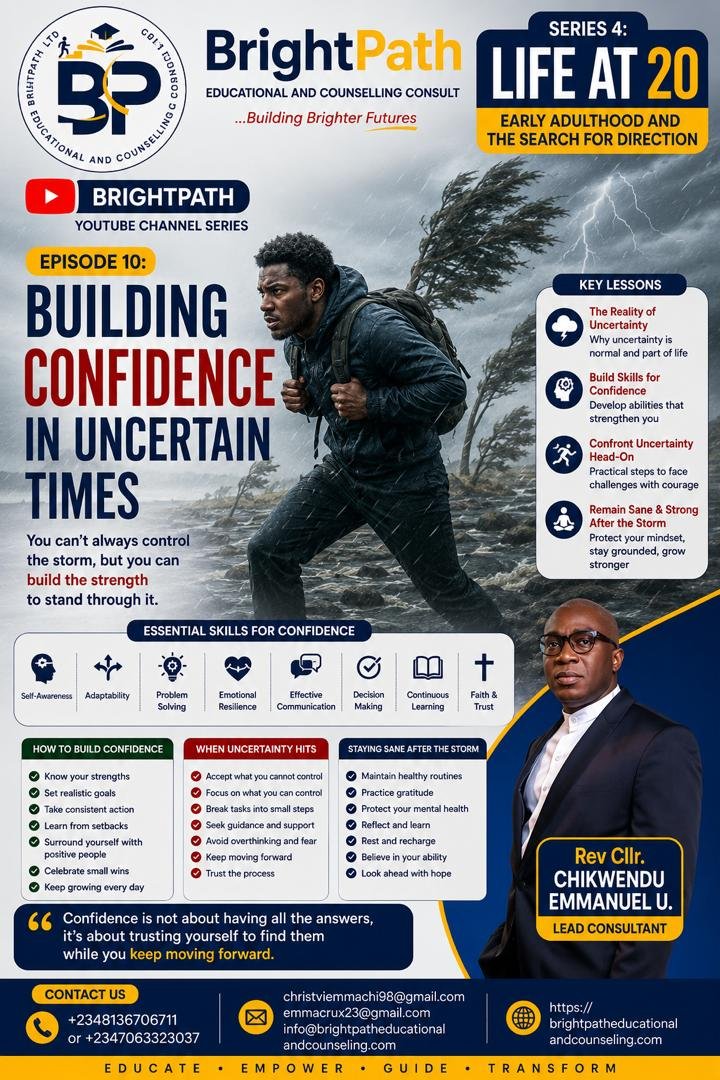
Confidence is not the absence of uncertainty.
Confidence is the ability to move forward despite uncertainty.
Question 2
Why Does Uncertainty Create Anxiety?
Human beings naturally seek:
- security,
- predictability,
- control,
- certainty.
When these appear threatened, anxiety may emerge.
Common fears include:
- fear of failure,
- fear of making wrong decisions,
- fear of disappointing others,
- fear of being left behind,
- fear of the unknown.
Question 3
Why Is Awareness Important?
Self-awareness helps individuals understand:
- their strengths,
- their limitations,
- their emotional triggers,
- their values,
- their coping styles.
Awareness transforms uncertainty from an enemy into information.
Questions to ask include:
- What exactly am I afraid of?
- What part of this situation can I control?
- What resources do I already possess?
- Who can support me?
Question 4
What Skills Help Build Confidence During Uncertain Times?
- Problem-Solving Skills
Focus on solutions rather than helplessness.
- Adaptability
The ability to adjust to changing circumstances is essential in adulthood.
- Communication Skills
Seeking help and expressing concerns improve resilience.
- Emotional Regulation
Managing emotions prevents panic-driven decisions.
- Decision-Making Skills
Good decisions are often made with incomplete information.
- Financial Literacy
Financial preparedness reduces uncertainty-related stress.
- Continuous Learning
Learning new skills creates opportunities and flexibility.
- Faith and Spiritual Resilience
Faith often provides hope when circumstances remain unclear.
Question 5
How Do We Confront Uncertainty When It Appears?
Accept Reality
Denial often increases distress.
Break Problems Into Smaller Steps
Large uncertainties become manageable through small actions.
Focus on What You Can Control
Control:
- effort,
- preparation,
- attitude,
- learning.
Release what cannot be controlled.
Seek Guidance
Mentors, counsellors, and trusted advisers can provide perspective.
Avoid Catastrophic Thinking
Not every uncertainty leads to disaster.
Continue Moving Forward
Progress creates momentum and confidence.
Question 6
How Do We Remain Mentally Healthy Afterwards?
After periods of uncertainty:
Reflect on Lessons Learned
Growth often becomes visible in hindsight.
⸻
Celebrate Progress
Small victories matter.
Maintain Healthy Routines
Protect:
- sleep,
- exercise,
- nutrition,
- social relationships.
Practice Gratitude
Gratitude improves resilience and emotional wellbeing.
Continue Building Confidence
Confidence grows through repeated experiences of overcoming challenges.
BrightPath Professional Tips
✔️ Confidence is built, not inherited.
✔️ Uncertainty is a normal part of adulthood.
✔️ Skills create confidence.
✔️ Preparation reduces fear.
✔️ Seek support when needed.
✔️ Focus on growth rather than perfection.
✔️ Build resilience through small daily victories.
✔️ Trust that not having all the answers today does not prevent success tomorrow.
Reflection Questions
Ask yourself:
- What uncertainty am I currently facing?
- What part of this situation can I control?
- What strengths have helped me overcome challenges before?
- What skills do I need to develop?
- Who can support me during this season?
Key Takeaways
- Uncertainty is a normal feature of life and early adulthood.
- Confidence is not certainty; it is the willingness to move forward despite uncertainty.
- Self-awareness and emotional intelligence improve resilience.
- Skills such as adaptability, communication, and problem-solving strengthen confidence.
- Growth often occurs in seasons of uncertainty.
- Support systems, mentorship, and faith can provide stability during difficult periods.
Closing
“Life at 20 is not about having all the answers. It is about developing the courage to keep moving while discovering them. Uncertainty may test your confidence, but it can also strengthen your character, sharpen your skills, and reveal strengths you never knew existed. Keep learning, keep growing, and keep moving forward.”