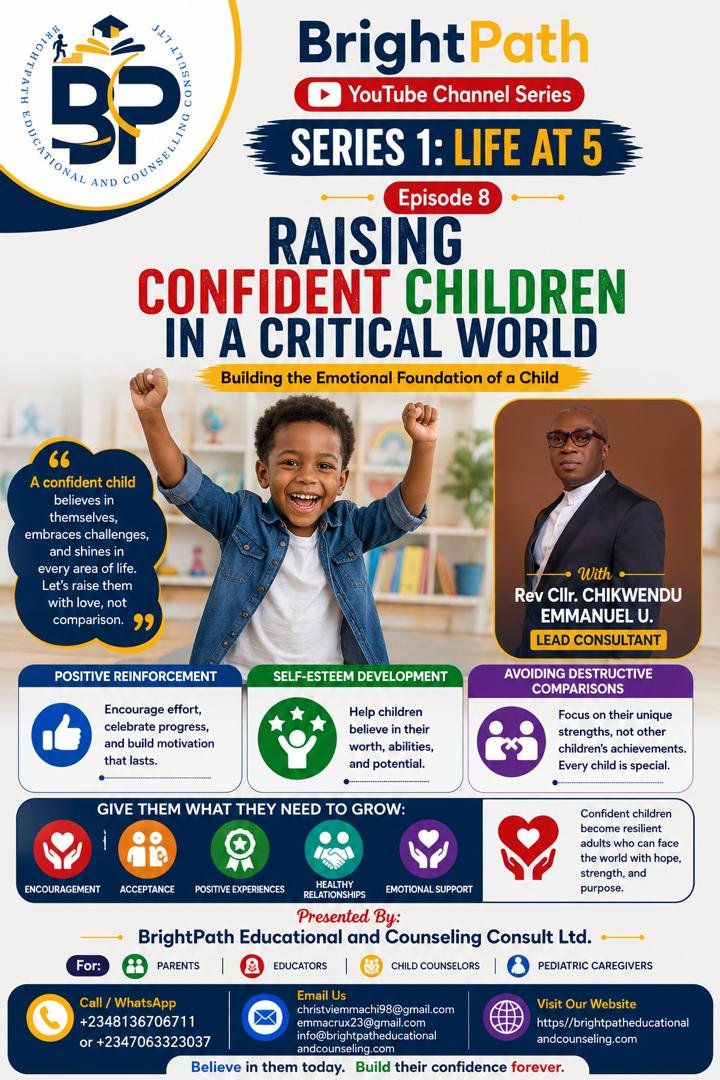
Episode 8: Raising Confident Children in a Critical World

Introduction
We live in a world where children are constantly evaluated, compared, corrected, and judged.
They may hear comments such as:
- “Why can’t you be like your brother?”
- “Your friend scored higher than you.”
- “You are too slow.”
- “You are not good enough.”
While adults may intend to motivate children, repeated criticism and unhealthy comparisons can quietly damage a child’s confidence.
Confidence is not something children are born with.
Confidence is built gradually through:
- Encouragement
- Acceptance
- Positive experiences
- Healthy relationships
- Emotional support
At age five, children are beginning to form beliefs about themselves.
They are asking questions such as:
“Am I capable?”
“Am I valued?”
“Can I succeed?”
“Do people believe in me?”
The answers they receive from adults help shape their self-image for years to come.
- Understanding Confidence in Childhood
What is Confidence?
Confidence is a child’s belief that:
- “I can learn.”
- “I can try.”
- “I can improve.”
- “I can handle challenges.”
Confidence is not perfection.
Confident children still:
- Make mistakes
- Experience failure
- Face challenges
But they believe they can recover and keep growing.
Confidence vs Arrogance
Many people confuse confidence with arrogance.
Confidence says:
“I can learn and improve.”
Arrogance says:
“I am better than everyone.”
Healthy confidence encourages growth, while arrogance seeks superiority.
- Why Early Confidence Matters
Children with healthy confidence are more likely to:
- Participate in class
- Ask questions
- Try new experiences
- Build friendships
- Solve problems independently
- Handle setbacks effectively
Confidence becomes the foundation for:
- Academic success
- Social development
- Emotional resilience
- Leadership skills
- Positive Reinforcement: A Powerful Tool
What is Positive Reinforcement?
Positive reinforcement means recognizing and encouraging desirable behavior.
When children receive positive feedback, they are more likely to repeat healthy behaviors.
Examples of Positive Reinforcement
Instead of saying:
“You should have done better.”
Try:
“I noticed how hard you worked on that task.”
Instead of focusing only on results, recognize:
- Effort
- Persistence
- Improvement
- Responsibility
Why Positive Reinforcement Works
Children thrive when they feel:
- Seen
- Appreciated
- Encouraged
- Valued
Positive reinforcement strengthens:
- Motivation
- Self-belief
- Emotional security
- Building Healthy Self-Esteem
What is Self-Esteem?
Self-esteem is how children feel about themselves.
It answers questions such as:
- “Am I important?”
- “Am I worthy?”
- “Do I have value?”
Healthy self-esteem develops when children consistently experience:
- Love
- Respect
- Acceptance
- Encouragement
Signs of Healthy Self-Esteem
Children with healthy self-esteem often:
- Express opinions confidently
- Accept mistakes
- Try new activities
- Handle criticism better
- Build positive friendships
Signs of Low Self-Esteem
Children may:
- Constantly doubt themselves
- Fear failure
- Avoid challenges
- Seek excessive approval
- Compare themselves negatively to others
- Everyday Ways to Build Self-Esteem
Listen Attentively
Children feel valued when adults genuinely listen.
Simple actions matter:
- Eye contact
- Active listening
- Respectful responses
Celebrate Progress
Do not wait for perfection.
Celebrate:
- Effort
- Growth
- Improvement
- Persistence
Give Age-Appropriate Responsibilities
Allow children to:
- Help with simple tasks
- Make small decisions
- Solve minor problems
Success builds competence.
Competence builds confidence.
Encourage Independence
Avoid doing everything for children.
Children become confident when they discover:
“I can do this myself.”
- The Harm of Destructive Comparisons
Why Comparisons Hurt
Many adults compare children in an attempt to motivate them.
Examples:
- “Your sister behaves better.”
- “Look at how smart your classmate is.”
- “Why can’t you be like your cousin?”
These statements often create:
- Shame
- Resentment
- Anxiety
- Insecurity
What Children Hear
When adults compare children, the child may interpret:
“I am not good enough.”
or
“I will only be loved if I perform better.”
Over time, these beliefs can damage self-worth.
- Every Child Develops Differently
Children grow at different rates.
Some children excel in:
- Academics
Others excel in:
- Creativity
- Leadership
- Sports
- Problem-solving
- Communication
Healthy development means recognizing each child’s unique strengths.
Replace Comparisons with Encouragement
Instead of:
“Why can’t you be like your brother?”
Try:
“Let’s work together to help you improve.”
This promotes growth rather than shame.
- Helping Children Develop a Growth Mindset
What is a Growth Mindset?
A growth mindset teaches children that abilities can improve through:
- Effort
- Practice
- Learning
- Persistence
Children learn:
“I may not be able to do it yet, but I can learn.”
Helpful Growth Mindset Statements
- “Mistakes help us learn.”
- “Keep trying.”
- “You are improving.”
- “Practice makes progress.”
- “I am proud of your effort.”
These messages build resilience and confidence.
- The Role of Parents, Teachers, and Counselors
Adults become mirrors through which children see themselves.
Children often believe what important adults repeatedly tell them.
If children hear:
- Encouragement
- Respect
- Hope
- Acceptance
they begin to see themselves positively.
If they hear:
- Criticism
- Humiliation
- Constant comparison
their confidence may weaken.
- Counseling Insight for Parents and Educators
Confidence grows when children experience:
Emotional Safety
Knowing they can make mistakes without losing love and acceptance.
Encouragement
Believing that effort is valuable.
Belonging
Feeling accepted and valued.
Opportunity
Having chances to learn and succeed.
The goal is not to raise perfect children.
The goal is to raise children who believe in their ability to grow.
Practical Confidence-Building Activities
Confidence Jar
Encourage children to write or draw:
- Achievements
- Kind acts
- New skills learned
Review them regularly.
Daily Encouragement Time
Spend a few minutes each day discussing:
- What went well
- What was learned
- What can improve
Strength Discovery Exercise
Ask children:
- What do you enjoy doing?
- What are you good at?
- What makes you feel proud?
Help them identify personal strengths.
Conclusion
Confident children are not children who never fail.
They are children who believe they can learn, grow, and recover from challenges.
Confidence develops through:
- Positive reinforcement
- Healthy self-esteem
- Encouragement
- Acceptance
- Freedom from destructive comparisons
When adults focus on growth rather than perfection, children become stronger, more resilient, and better prepared for life’s challenges.
BrightPath Closing Reflection
“A confident child is not one who never makes mistakes, but one who knows that mistakes do not define their worth. Every encouraging word, every opportunity to grow, and every act of acceptance helps build a child who believes, ‘I am capable, I am valuable, and I can succeed.’ In a critical world, confidence becomes a child’s protective shield and a foundation for lifelong success.”