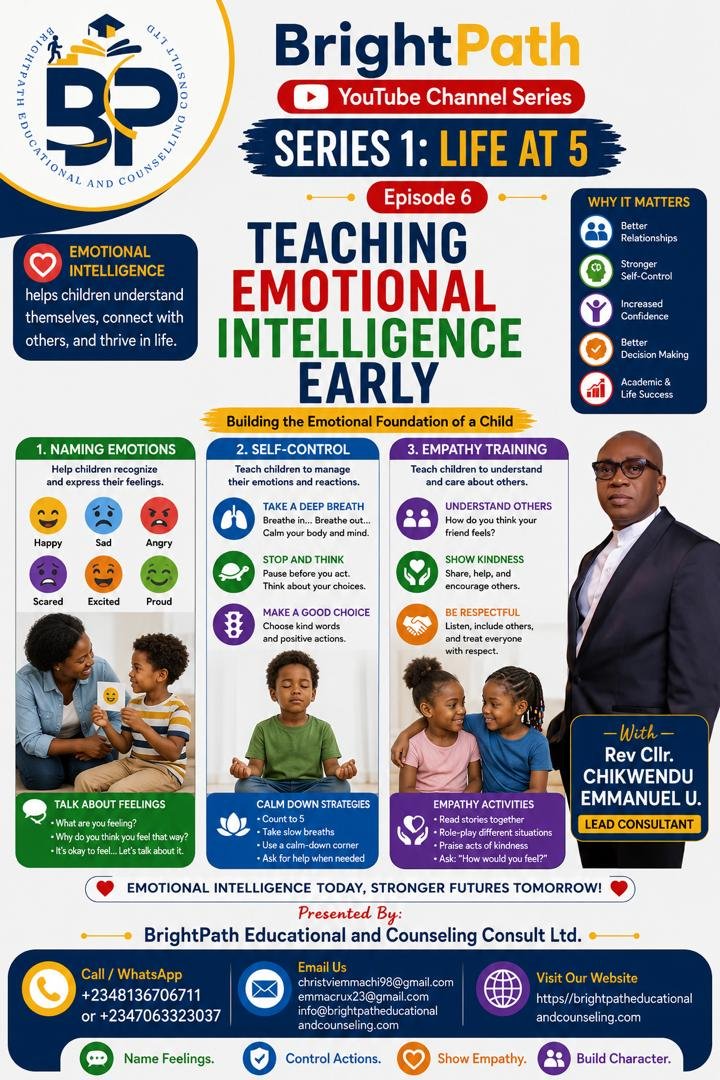
Episode 6: Teaching Emotional Intelligence Early

Introduction
One of the greatest gifts adults can give a child is not money, toys, or academic achievement alone—it is emotional intelligence (EI).
Emotional intelligence is the ability to
- Understand emotions
- Manage emotions
- Express emotions appropriately
- Understand the feelings of others
- Build healthy relationships
Research and practical experience consistently show that emotionally intelligent children often become adults who are
- More resilient
- Better communicators
- More confident
- More empathetic
- Better decision-makers
At age five, children are at a crucial stage where emotional intelligence can be intentionally taught and nurtured.
The earlier emotional intelligence is developed, the stronger the child’s emotional foundation becomes.
- What is Emotional Intelligence?
Simple Definition
Emotional Intelligence is the ability to:
Recognize emotions
Knowing what you are feeling.
Understand emotions
Knowing why you feel that way.
Manage emotions
Responding appropriately rather than reacting impulsively.
Recognize others’ emotions
Understanding how others feel.
Build healthy relationships
Interacting positively with people.
Why Emotional Intelligence Matters
Children with healthy emotional intelligence often:
- Handle frustration better
- Resolve conflicts peacefully
- Develop stronger friendships
- Learn more effectively
- Show greater confidence
Academic success is important, but emotional intelligence often determines how well children navigate life.
- Naming Emotions: The First Step to Emotional Intelligence
Why Naming Emotions Matters
Children cannot manage emotions they cannot identify.
Many young children experience emotions but lack the vocabulary to describe them.
Instead of saying:
“I feel disappointed.”
A child may:
- Cry
- Shout
- Withdraw
- Throw a tantrum
Teaching emotional vocabulary helps children communicate their inner experiences.
Common Emotions Children Should Learn
Happy
Feeling joy and excitement.
Sad
Feeling hurt or disappointed.
Angry
Feeling frustrated or upset.
Scared
Feeling threatened or worried.
Worried
Feeling uncertain about something.
Excited
Feeling eager or enthusiastic.
Proud
Feeling good about an achievement.
Embarrassed
Feeling uncomfortable or self-conscious.
Practical Ways to Teach Emotional Vocabulary
During Daily Conversations
Ask:
- “How are you feeling today?”
- “What emotion are you feeling?”
- “Can you tell me what made you feel that way?”
During Storytelling
Ask:
- “How do you think the character feels?”
- “Why is the character sad?”
During Play
Use dolls, toys, and role-play to discuss emotions.
Emotional Vocabulary Exercise
Instead of:
“Stop crying.”
Try:
“Are you feeling sad, disappointed, or frustrated?”
This helps children connect feelings to words.
- Teaching Self-Control
What is Self-Control?
Self-control is the ability to:
- Pause before reacting
- Manage strong emotions
- Follow rules
- Make thoughtful choices
Young children naturally struggle with self-control because their brains are still developing.
Self-control is learned gradually through guidance and practice.
Why Self-Control Matters
Children with self-control are more likely to:
- Focus on school
- Follow instructions
- Build positive friendships
- Handle disappointment constructively
Understanding Emotional Reactions
When a child:
- Screams
- Hits
- Throws objects
- Cries intensely
The child is not necessarily being “bad.”
The child may simply be overwhelmed emotionally.
The goal is not punishment first.
The goal is to teach emotional regulation.
Practical Self-Control Strategies
Teach deep breathing.
Encourage children to:
- Take slow breaths
- Count slowly
- Relax before responding
Create Calm-Down Spaces
Provide a safe area where children can:
- Relax
- Reflect
- Regain emotional control
Model Self-Control
Children learn emotional regulation by observing adults.
Parents who manage anger calmly teach children how to do the same.
- Empathy Training: Helping Children Understand Others
What is Empathy?
Empathy is the ability to:
- Recognize another person’s feelings
- Understand their emotional experience
- Respond with care and kindness
Empathy helps children move beyond:
“What do I want?”
to:
“How does this affect others?”
Why Empathy is Important
Empathetic children are more likely to:
- Share willingly
- Help others
- Show kindness
- Build strong friendships
- Reduce aggressive behavior
- How Empathy Develops
At age five, children are beginning to understand that:
- Other people have feelings
- Other people may think differently
- Actions affect others emotionally
This is an important developmental milestone.
Practical Empathy Activities
Ask Reflective Questions
When conflicts occur, ask:
- “How do you think your friend feels?”
- “What would make them feel better?”
- “How would you feel if that happened to you?”
Use Stories and Books
Stories help children experience different perspectives.
Ask:
- “Why do you think the character is sad?”
- “What could someone do to help?”
⸻
Encourage Acts of Kindness
Examples:
- Sharing toys
- Helping classmates
- Comforting upset friends
- Writing thank-you notes
Kind actions strengthen empathy.
- Emotional Intelligence in Schools and Homes
Children learn emotional intelligence most effectively when parents and teachers work together.
At Home
Parents can:
- Discuss emotions openly
- Model respectful communication
- Encourage emotional expression
- Teach problem-solving
At School
Teachers can:
- Create emotionally safe classrooms
- Encourage cooperation
- Teach conflict resolution
- Recognize children’s feelings
- Common Mistakes Adults Make
Ignoring Feelings
Saying:
“Stop crying.”
instead of helping children understand emotions.
Shaming Emotions
Statements such as:
“Big boys don’t cry.”
may discourage healthy emotional expression.
Solving Every Problem
Children need opportunities to practice emotional problem-solving themselves.
- Long-Term Benefits of Emotional Intelligence
Children who develop emotional intelligence early often grow into adults who:
- Build healthy relationships
- Communicate effectively
- Manage stress better
- Lead with empathy
- Make responsible decisions
- Adapt to challenges successfully
Emotional intelligence becomes a lifelong asset.
Counseling Insight for Parents and Educators
Every emotional moment is a teaching opportunity.
A tantrum can become a lesson in self-control.
A disagreement can become a lesson in empathy.
A disappointment can become a lesson in emotional resilience.
Children learn emotional intelligence not from lectures but from daily interactions with caring adults.
Conclusion
Teaching emotional intelligence early helps children:
- Understand emotions
- Express feelings appropriately
- Develop self-control
- Build empathy
- Form healthy relationships
- Become emotionally resilient
Children who understand emotions are better equipped to understand themselves and the world around them.
Emotional intelligence is not an optional skill—it is a foundation for lifelong well-being.
BrightPath Closing Reflection
“Children are not born knowing how to manage emotions; they learn from the adults who guide them. Every time we help a child name a feeling, control a reaction, or understand another person’s emotions, we are building emotional intelligence that can benefit them for a lifetime. Emotional intelligence is not taught in a single lesson—it is nurtured every day through patience, guidance, and love.”